What Is a Link Document in Real Estate? A Simple Guide for Property Buyers
Learn what a link document in real estate means, how it helps explain property ownership history, and how it connects with sale deed, title deed, and EC.

Table of Contents
What Is a Link Document in Real Estate?
What Is a Link Document in Real Estate is a common question among property buyers, first-time investors, and families trying to understand land documents in simple language. In property transactions, link documents are commonly referred to as documents that help explain the recorded ownership history of a property.
Every property usually has a history. It may have moved from one owner to another through sale, gift, inheritance, partition, settlement, or other legally recorded transactions. Link documents help connect these earlier transactions and show how the property reached the present owner or selling party.
This article explains the meaning of link documents, why they are discussed during property transactions, how they relate to sale deed, title deed, and Encumbrance Certificate, and what readers should generally understand about the ownership chain of a property.
Quick Summary
- A link document helps explain the previous ownership history of a property.
- It connects earlier transactions and shows how ownership moved from one party to another.
- Link documents are commonly reviewed along with sale deed, title records, EC, and other property documents.
- They help understand the chain of title in real estate.
- The number and type of link documents may vary depending on the property history.
- A link document is not the same as an Encumbrance Certificate.
- Professional legal guidance may be required to interpret link documents correctly.
Table of Contents
- Link Document Meaning in Simple Words
- Why Are Link Documents Used in Property Transactions?
- How Link Documents Show Ownership History
- Examples of Link Documents in Real Estate
- Link Document vs Sale Deed vs Title Deed vs EC
- What Is Chain of Title in Real Estate?
- Common Misconceptions About Link Documents
- How Link Documents Connect With Other Property Records
- Frequently Asked Questions
- Final Thoughts
Link Document Meaning in Simple Words
A link document is a property document that helps connect the present ownership record with earlier ownership records. It acts like a connecting piece in the property's documented history.
For example, if Owner A sold land to Owner B, and Owner B later sold it to Owner C, the sale deed between A and B may be treated as a link document when Owner C is involved in a later transaction. It helps explain how Owner B received rights before transferring them further.
In simple terms, link documents help answer this question:
How did the present owner or selling party get the property?
This is why link documents are often discussed during legal due diligence, property registration preparation, resale transactions, loan processing, and ownership history review.
Why Are Link Documents Used in Property Transactions?
Link documents are used because ownership is not always understood from one document alone. A current sale deed may show the latest transaction, but earlier documents may be required to understand how the property moved over time.
In real estate, especially land and plotted developments, the ownership history may include several stages. Land may have been purchased, inherited, divided, developed, converted, or transferred between multiple parties. Link documents help explain this journey.
During a property transaction, the documentation process may vary depending on the project, property type, legal structure, developer process, and legal advice involved. Link documents are usually understood as part of the broader document review process rather than as a standalone decision-making document.
Did You Know? A link document does not create a new transaction by itself. It helps explain an earlier transaction in the ownership chain of a property.
How Link Documents Show Ownership History
Think of property ownership as a chain. Each legally recorded transfer is one link in that chain. If the chain is continuous, it becomes easier to understand how ownership moved from one person or entity to another.
Link documents may show details such as previous owner name, buyer or transferee name, nature of transfer, survey number, property details, document number, registration date, extent of land, boundaries, and Sub-Registrar Office details.
When these details are studied together, they help form a picture of the property's recorded ownership history. This is why link documents are commonly discussed along with sale deed, title deed, Encumbrance Certificate, and registration records.
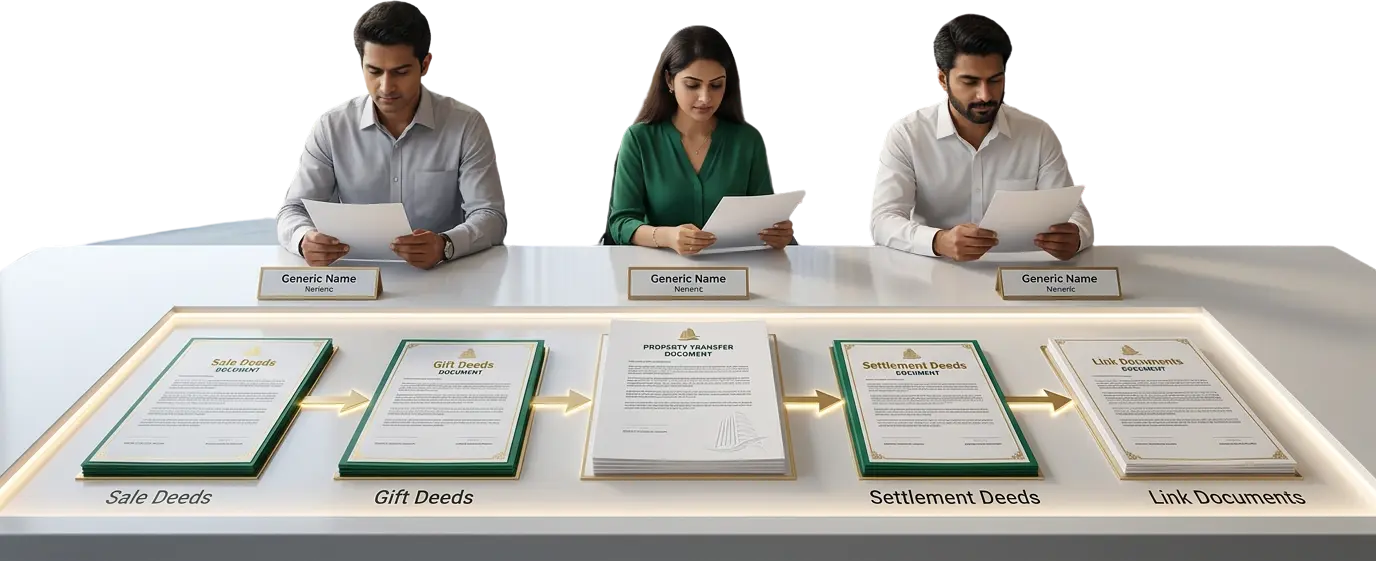
Examples of Link Documents in Real Estate
The type of link document depends on how the property changed hands in the past. Not every property will have the same document history.
Common examples may include:
- Previous sale deed
- Gift deed
- Partition deed
- Settlement deed
- Release deed
- Exchange deed
- Development agreement, where applicable
- Registered power of attorney, where applicable
- Inheritance-related documents, where applicable
- Court order or decree, where applicable
These documents are not automatically present in every transaction. The document set depends on the property's history and the nature of ownership transfer. A property with a simple sale history may have fewer link documents, while a property that passed through family partition, inheritance, or development agreements may have a more detailed document trail.
Link Document vs Sale Deed vs Title Deed vs EC
Many readers get confused between link document, sale deed, title deed, and Encumbrance Certificate. They are related, but they do not mean the same thing.
| Document | Simple Meaning | Main Purpose |
|---|---|---|
| Link Document | Earlier document in the ownership chain | Helps explain how ownership moved over time |
| Sale Deed | Registered document recording sale transfer | Records transfer from seller to buyer |
| Title Deed | Document associated with ownership rights | Helps establish ownership interest |
| Encumbrance Certificate | Record of registered transactions for selected period | Shows registered entries such as sale, mortgage, or release |
For a simple explanation of related documents, you can also read Sale Deed vs Title Deed and What Is an Encumbrance Certificate.
What Is Chain of Title in Real Estate?
Chain of title means the sequence of ownership transfers for a property. It helps explain how ownership moved from earlier parties to the current owner or selling party.
A clear chain of title usually means that each transfer is understandable through supporting documents. If an important link is missing, unclear, or inconsistent, legal professionals may examine the matter more carefully.
In practical terms, chain of title helps answer who owned the property earlier, how ownership transferred, whether the transfer was recorded, whether property details match across documents, and whether the present ownership record connects with earlier records.
Expert Note: Link documents are best understood as part of a sequence. One document alone may not explain the complete story, but the connected set of documents helps explain the recorded ownership journey.
Common Misconceptions About Link Documents
Because link documents are often discussed in legal review, many people misunderstand their role. Here are a few common misconceptions:
- Misconception 1: A link document is the same as the current sale deed.
- Reality: A link document usually refers to an earlier document in the ownership chain.
- Misconception 2: One document always explains full ownership history.
- Reality: Some properties may require several documents to understand the ownership chain.
- Misconception 3: Link documents replace EC.
- Reality: Link documents and EC serve different purposes and are often reviewed together.
- Misconception 4: Every property has the same number of link documents.
- Reality: The number of documents depends on the property's history.
Understanding these differences helps readers approach property documents with more clarity and less confusion.
How Link Documents Connect With Other Property Records
Link documents do not work in isolation. They are commonly understood along with other property records such as Encumbrance Certificate, sale deed, title records, survey details, revenue records, approval documents, and registration records.
For example, the details in link documents may be compared with the Encumbrance Certificate to understand whether registered entries appear consistently. They may also be compared with survey number details, boundaries, extent of land, and ownership names.
During property transactions, the documentation shared and reviewed may differ depending on the transaction stage, property type, developer documentation process, and the advice of legal professionals involved.

Why Link Documents Matter for Property Understanding
Link documents matter because they help explain history. A property without context can be difficult to understand. Link documents provide that context by connecting earlier transfers and showing how the present ownership position was reached.
For buyers, investors, families, lenders, and legal professionals, link documents can support a better understanding of the property file. They are part of the broader documentation picture and should be interpreted in the correct legal and transactional context.
However, link documents should not be viewed as a shortcut or a single final answer. Like other property records, they are best understood with professional guidance where required.
How This Guide Connects With Your Learning Journey
This article is part of the Sri Supraja Infracon Investor Knowledge Center. If you are learning about property documentation, continue with these related guides:
- Documents Required Before Buying a Plot in Telangana
- What Is an Encumbrance Certificate
- How to Verify Land Ownership Before Buying a Plot
- HMDA vs DTCP vs RERA
You can also explore Sri Supraja Infracon projects to learn more about our planned plotted developments.
Frequently Asked Questions
What is link document in real estate?
A link document is a property document that helps explain earlier ownership transactions and connects the present ownership record with previous records.
Why is it called a link document?
It is called a link document because it links one ownership transaction to another and helps form the ownership chain of a property.
Is link document same as sale deed?
Not exactly. A previous sale deed can act as a link document, but the current sale deed records the present transaction. The meaning depends on the stage of ownership being reviewed.
Is link document same as title deed?
No. A title deed relates to ownership rights, while link documents help explain earlier transactions in the ownership chain.
How many link documents can a property have?
The number may vary depending on how many times the property changed hands and the type of transactions involved.
Do link documents replace Encumbrance Certificate?
No. Link documents and EC serve different purposes. EC shows registered transaction entries for a selected period, while link documents explain ownership transfer history.
Who reviews link documents?
Link documents may be reviewed by legal professionals, buyers, sellers, lenders, developers, and registration-related professionals depending on the transaction.
Are link documents needed for every property?
The documentation considered may vary from case to case. The need for link documents depends on property history, transaction type, and legal advice.
Final Thoughts on What Is Link Document in Real Estate
Understanding what is link document in real estate helps readers understand how property ownership history is connected through earlier records. Link documents explain how a property moved from one party to another and how the present ownership position was reached.
They are commonly discussed along with sale deed, title deed, Encumbrance Certificate, and other property documents. However, every transaction is different, and the documents reviewed may vary depending on the property, process, and legal guidance involved.
At Sri Supraja Infracon, our Investor Knowledge Center is created to explain real estate concepts in a simple, balanced, and practical way. Continue learning through our guides or explore Sri Supraja Infracon projects for more information about our plotted developments.
Explore Premium Projects
Related Blogs
What Is an Encumbrance Certificate (EC)? A Simple Guide for Property Buyers
An Encumbrance Certificate, commonly known as EC, is an important property document that shows registered transactions linked to a property for a selected period. This simple guide explains what EC means and how it is used.
Sale Deed vs Title Deed: What's the Difference When Buying a Plot?
Sale deed and title deed are often used together, but they do not mean the same thing. This guide explains the difference, why both matter, and what buyers should verify before purchasing a plot.
Plot Registration Process in Telangana: Step-by-Step Guide (2026)
Understand the plot registration process in Telangana with this practical step-by-step guide covering documents, sale deed preparation, registration charges, SRO visit, biometric verification, and buyer checklist.
Looking for DTCP & RERA Approved Plots?
Explore premium plotted developments by Sri Supraja Infracon across Hyderabad growth corridors.